


Across the economy, U.S. consumers are experiencing a surge in the price of new vehicles. The increased rates come as the demand for newer models exceeds the current supply. As a result, dealerships across the nation are witnessing a dramatic increase in auto loan fraud as consumers begin to inflate their annual incomes to secure favorable loans following aggressive hikes in interest rates amid the international inventory crisis.
The global shortage of semiconductor microchips has forced automotive manufacturers to halt production on nearly 1.2 million new vehicles since 2020, catapulting the automotive retail industry into an inventory crisis. Although supply chain analysts estimate that global supply-demand levels will reach equilibrium in 2023, the trickle-down effects of the inventory shortage will yield long-term consequences that will impact the automotive and adjacent industries for years to come.
Since its inception, the inventory shortage has driven up the price of new vehicles, increased the price and demand for used vehicles, and surged annual interest rates for auto loans. Consequently, the shortage has stifled consumers’ negotiating and purchasing power at dealerships across the globe.
The financial pressures accompanying the crisis have inspired fraudsters to re-engage fraud schemes that were popularized during the pandemic. Automotive loan fraud has increased by 260% since 2021, and fraud experts believe that this increase will be a long-term side effect of the global inventory shortage.
Automotive dealers were already reporting higher levels of synthetic identity fraud, income misrepresentation, and employment fabrication following the pandemic. However, the reports have reached record highs as consumers struggle to purchase and finance vehicles through honest means. That’s why fraud experts are urging dealers to remain vigilant in their efforts to prevent and combat fraud schemes involving misrepresentation.
History Has its Eyes on Fraud
As history will show, financial crises have long served as a catalyst for fraudulent activity in the automotive industry. During the financial recession of 2008, consumers stopped purchasing new vehicles due to a severe lack of disposable income. This, of course, had a trickle-down effect that closely resembles our current climate. At that time, auto lenders saw a significant spike in the levels of early payment default – much of which was caused by fraud and misrepresentation on applications.
Much like today, the financial pressures of the recession inspired consumers to finance used cars and, simultaneously, forced automotive dealers to drive up annual interest rates. Naturally, this affected loan performance, causing a rise in early payment default, or EPD, and delinquency rates. We are noticing similar trends in loan performance as U.S. inflation rates reach record highs.
In addition to the global inventory shortage, the U.S. is experiencing rapid growth in inflation rates as a result of the supply chain disruptions. Together, the global crises are creating economic challenges that are known to activate fraud. We turned to consortium data to determine the true relationship between ongoing global crises and recent fraud activity.
To What Degree is the Inventory Shortage and Inflation Impacting Fraud?
Using our consortium data, Point Predictive has identified a strong correlation between growing inflationary pressures, the ongoing inventory shortage, and fraudulent activity in the auto lending market. In our analysis, we found that loan applications are more likely to contain fraud during periods of economic instability. We discovered this using Point Predictive’s Auto Fraud Manager solution, which leverages loan-application data to generate a risk score that reveals an application’s likelihood of containing misrepresentation or early payment default risks. The higher the score, the greater the risk of misrepresentation or default.
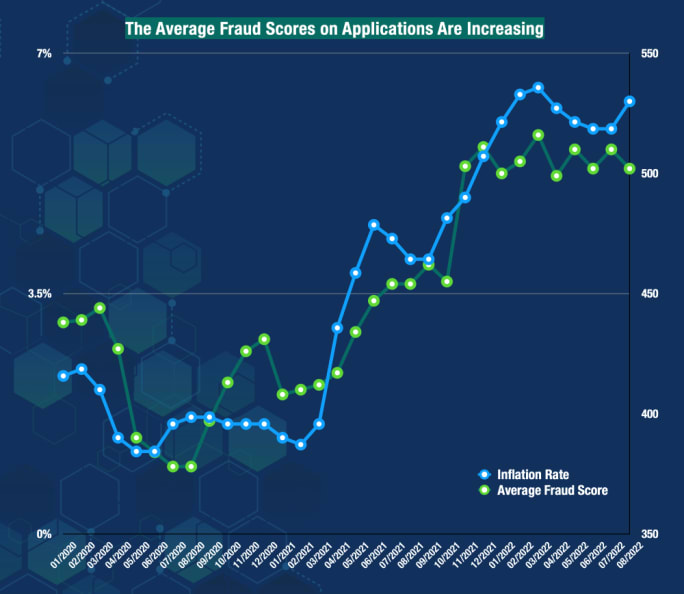
Inflation and average fraud scores
Point Predictive
To best understand the combined impact of inflation and the inventory shortage on fraud risks, we assessed the relationship between interest rates and EPD rates across the industry. Data from our analysis revealed a 0.76 correlation between EPD rates and inflation, meaning rising inflation rates are impacting consumers' ability to meet payment deadlines.
Further analysis indicated that climbing EPD rates are being driven by misrepresentation on loan applications. Evidence suggests that borrowers are marginally inflating their incomes to keep up with inflation rates and appear more attractive to sellers. The fact is that EPDs linked to income inflation have grown from 8% to 23% since March 2021.
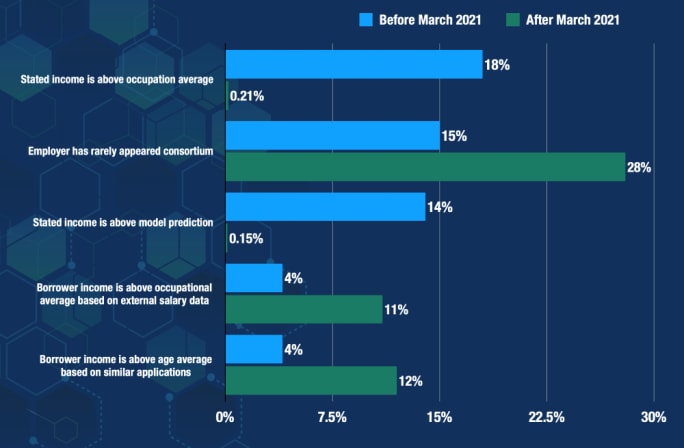
EPD and income misrepresentation
Point Predictive
Although it's among the most popular forms of misrepresentation, our analysis shows that income fraud is not the only type of fraud increasing with inflation and contributing to higher EPD rates. Data reveals that synthetic identity fraud, employment fabrication, pay stub falsification, straw borrower fraud, and collateral fraud are also on the rise.
Fraud is growing at an alarming rate, and dealers have to combat suspicious activity to avoid costly buybacks from lenders. Being proactive and eliminating potential fraud risk could make the difference between a dealership keeping its doors open long after the inventory shortage has passed, or going out of business.
McKenna is chief fraud strategist at Point Predictive.


