





DETROIT - Investigations into whatever is lurking behind Toyota's crisis of quality have put a spotlight on all that can go wrong with auto electronics — the growing number of wires, sensors and computer chips that have profoundly changed the automobile in the last decade, The Associated Press reported. Though no smoking circuit has been found so far, a picture is emerging that shows the automobile industry's technology is racing ahead of quality-control testing and regulators. It's troubling not only for Toyota owners but for drivers of any modern car that's basically a computer on wheels. Toyota insists that electronics played no role in the unintended acceleration that has sparked its massive recalls, and no one has been able to disprove it. Lawyers, regulators, engineers and politicians aren't so sure. The auto industry has been moving at Pentium speed since the late 1990s to replace mechanical cables and other devices with computers to control everything from brakes to throttles to power steering. Automakers say electronics have made vehicles safer with devices such as air bags and antilock brakes. It's also made cars more fuel efficient, cleaner and, usually, more reliable. Still, things can go wrong and diagnosing problems is complicated. Glitches can include buggy software, circuitry that's randomly influenced by electrical interference and shorts caused by microscopic "whiskers" that sprout from solder. It can be one or more of these problems, as well as environmental factors — a blast from a heater vent or moisture from the road — that can cause a failure. Age also can be a factor. "You're looking for a needle in a haystack," Raj Rajkumar, an electrical and computer engineering professor at Carnegie Mellon University in Pittsburgh, told AP. "Those are very hard to reproduce. The problem happens and you go back and check and it's not there. The normal tendency is to blame it on the driver and go on." And that's what Toyota did initially. Drivers complained their vehicles accelerated out of control — without stepping on the gas. But complaints were largely dismissed by Toyota, its dealers and government regulators, who blamed mechanical problems or drivers stepping on the wrong pedal. Toyota, which until recently had a reputation for being high-quality and cutting-edge, began replacing mechanical accelerators with electrical ones starting with the Camry in 2002. Since the 2007 model year, all its cars have been equipped with the high-tech throttle. An analysis of complaints by the auto safety research firm Quality Control Systems, found that the number of Toyota "speed control" complaints received by the National Highway Traffic Safety Administration tripled since the electronic throttles were introduced. NHTSA says 34 people have died because of sudden acceleration crashes in Toyotas since 2000. But the issue didn't get much attention from Toyota until an off-duty California Highway Patrol officer and three members of his family were killed when their loaner Lexus sped out of control and crashed into traffic near San Diego. The Aug. 28 crash received widespread media coverage. Just over a month later, on Oct. 5, the automaker recalled 3.8 million Lexus and Toyota models in the U.S. because of floor mats. In January, it recalled 2.3 million because of sticky acclerators. It later added more than a million to the floor mat recall, and also said some cars might be covered by both. So far, more than 8 million vehicles have been recalled worldwide to replace floor mats or fix pedals that get stuck because of condensation. Toyota's denial that electronics played a role in the problems has been repeatedly challenged. Questions linger, including why, according to a congressional analysis, 70 percent of Toyota speed control complaints involve vehicles not covered by the floor mat or sticky pedal recall. Jim Lentz, president of Toyota Motor Sales USA Inc., was asked at a congressional hearing this week if he could say with certainty that the fixes now being undertaken would completely eliminate unintended acceleration problems. Lentz replied: "Not totally."
Toyota Crisis Puts Spotlight on Auto Electronics
More Industry

Price Driving Insurance Churn
Over half of insurance holders ages 18 to 29 reported to be 'somewhat' likely to change providers in the next 90 days, according to CivicScience, which found that interest was lower among older age groups.
Read More →
AI Drives Dealer Website Traffic
Total visits to dealer websites from generative artificial intelligence platforms grew more than 15 times year-over-year, signaling a shift in how many consumers shop for cars online.
Read More →
Automakers Tops in Fuel Economy
In the U.S., Honda has the most efficient gas-electrified combo lineup while Tesla beats all automakers in annual EPA ranking as brands built their alternative-fuel offerings.
Read More →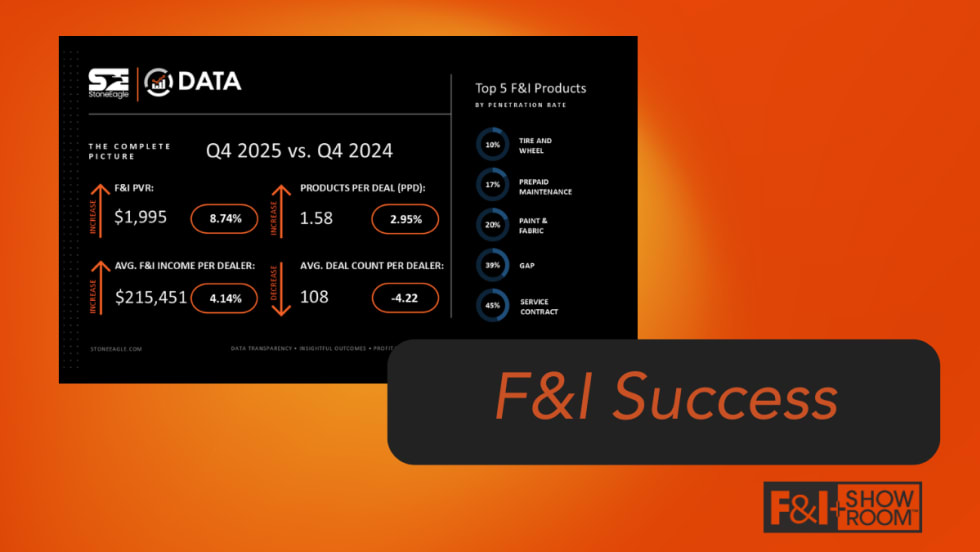
Report Finds Year-End F&I Strength
Deal volume ebbed and flowed throughout 2025, but product performance remained steady, according to automotive technology and data intelligence solutions provider StoneEagle.
Read More →
Overall Consumer Confidence Up
Americans’ view of present business conditions, the labor market and family finances, though, are still in the dumps, and if they plan to buy cars, many target used units.
Read More →
Auto Loan Forecast Bucks Market Trend
Auto loan originations rose over 6% year-over-year in the third quarter of 2025, but TransUnion predicts a slight decline in auto loan growth this year, making it an outlier in the company's overall lending forecast.
Read More →
Some Auto Brands Cheaper to Insure
A new top 10 list ranks the least expensive for average full insurance coverage on a clean driving record and high driver credit scores.
Read More →
Learn to Manage the Mayhem at Agent Summit
Rob Mancuso – president of Mancuso Automotive – will present a Keynote at the 2026 event.
Read More →
Auto Recalls Sank Last Year
2025 Sedgwick data indicate that the number of vehicles affected fell to its lowest point in more than a decade.
Read More →
Affordability Leads Top-Rated List
Edmunds’ editorial team tested 300-plus vehicles to help determine the Top Rated Awards for 2026, and one brand stood out with multiple rankings, including Best of the Best.
Read More →