



Many automotive consumers are refinancing their loans to achieve greater affordability.
Second-quarter data compiled by Experian show refinances in the segment jumped 70% year-over-year.
 MENU
MENU SEARCH
Q2 activity led by credit unions. Average industrywide monthly payment still rises.

Consumers who refinanced in the quarter trimmed 2% from their interest rates to an average of 8.45%, cutting the average monthly payment by $71.
Pexels/Jakub Zerdzicki
Many automotive consumers are refinancing their loans to achieve greater affordability.
Second-quarter data compiled by Experian show refinances in the segment jumped 70% year-over-year.
“Although affordability continues to be a topic of conversation in the automotive industry, with interest rates trending downward, we’re seeing more borrowers taking the opportunity to lower their monthly payments,” said Head of Automotive Financial Insights Melinda Zabritski.
Consumers who refinanced in the quarter trimmed 2% from their interest rates to an average of 8.45%, cutting the average monthly payment by $71, Experian said.
Despite the activity, the average new-vehicle loan amount rose more than $1,000 to $41,983, and the average used-vehicle loan amount increased $481 to $26,795.
Credit unions handled the bulk of auto refinances in the quarter, according to the research, raising their share of the market from 63% to 68%, followed by banks at about 22%. Consumers refinancing through credit unions cut their monthly payments by $87, while those who did so through banks reduced theirs by $46.
But when it comes to auto financing overall, banks led with about 28% of the market, up from about 25% a year earlier, Experian found. Meanwhile, captive lenders’ share fell from 30% to about 27% while credit unions added one percentage point share to 21%.
Captives, though, led the way in new-vehicle financing at 52%, which is down from 61% a year earlier.
Banks, meanwhile, grew their leading share of used-vehicle financing from 27% to 29%.
“The shift in lender market share highlights an increasingly competitive landscape for automotive financing,” Zabritski said. “With banks showing a renewed focus in automotive combined with new OEM relationships, we’re seeing a completely different environment. In an ever-evolving industry, leveraging the most current data can help automotive professionals identify emerging patterns and adapt to changing dynamics.”
REPORT: State of the Automotive Finance Market

Over half of insurance holders ages 18 to 29 reported to be 'somewhat' likely to change providers in the next 90 days, according to CivicScience, which found that interest was lower among older age groups.
Read More →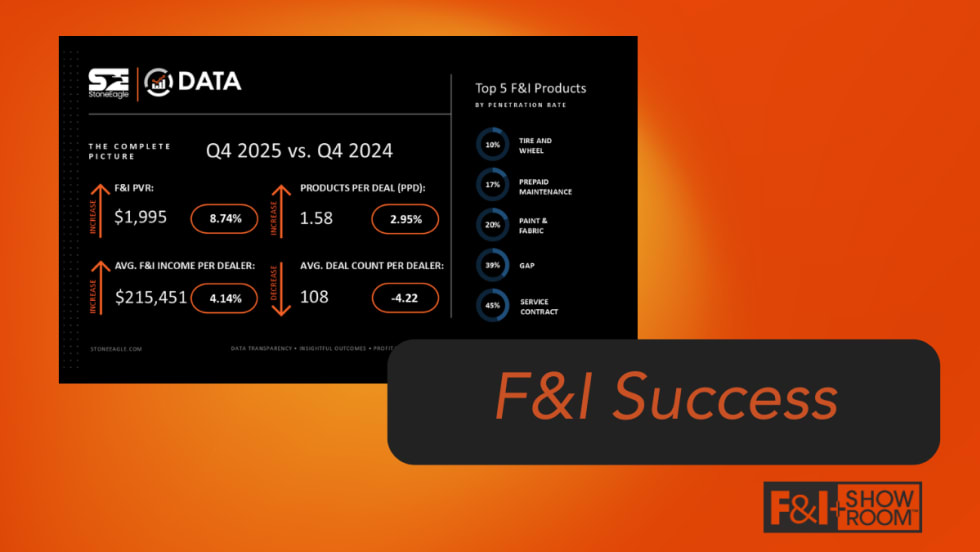
Deal volume ebbed and flowed throughout 2025, but product performance remained steady, according to automotive technology and data intelligence solutions provider StoneEagle.
Read More →
Joel Kansanback – CEO of Strategic Dealer Advisory – will take to the stage at the 2026 event.
Read More →
A new top 10 list ranks the least expensive for average full insurance coverage on a clean driving record and high driver credit scores.
Read More →
A TransUnion study found that relationship-driven sales models proved to be important, as consumers who used an agent had a lower shopping intensity than those going it alone.
Read More →
2025 brought consumers relief after years of rate hikes, but 2026 could bring renewed policy pain, depending on how U.S. trade policy affects prices.
Read More →
An annual report on the revenue stream finds more consumers are opting out as they face high car prices and overall inflation, and it recommends tweaks to increase success.
Read More →
December brought some of the best borrowing availability for consumers in years, though lenders tightened their reins on riskier segments of the market.
Read More →
Auto dealerships work better when all staffers own their duties.
Read More →
StoneEagleData reveals the gross reality behind the rise in EV leasing and the steady role F&I offices played.
Read More →