agent Entrepreneur logo
MenuMENU
SearchSEARCH

Transmogrification

The new dealer compliance roadway of the Trump administration.

by Terry O'Loughlin
January 9, 2025
Transmogrification

The possibility that regulation and prosecutions may be diminished does not mean that dealers needn’t be diligent regarding their compliance duties. 

Credit:

Pexels/Pixabay

10 min to read


"Transmogrification" means to change something from one form to another. In the present case, an apt analogy would be changing a frog into a prince. Dealer regulation will undoubtedly metamorphose on both federal and state levels. 

The shrieks can be heard throughout that mysterious land of consumer advocacy. Federal agencies, primarily the Federal Trade Commission and the Consumer Financial Protection Bureau, will no longer be fully aligned with consumer interest groups that have long reviled the dealer community. These agencies include the National Consumer Law Center (NCLC), Public Interest Research Group (PIRG), Consumer Federation of America (CFA), National Association of Consumer Advocates (NACA), Public Citizen, the American Bar Association (ABA), and the Center for Responsible Lending (CRL). Moreover, the attorneys general of the blue states belong to the Democratic Attorneys General Association. The DAGA website provides compelling evidence that these attorneys general are already steeling themselves for the change in administration, as these two quotes typify:

Ad Loading...
  • “Attorneys general from coast to coast have been preparing for months amid the competitive White House race,” – California’s Attorney General Rob Bonta (D)

  • Massachusetts Attorney General Andrea Campbell (D) said she’s “.. on alert for threats to … consumer protections and other issues,” and related further that she has “real concerns about the president-elect’s position when it comes to the rule of law… The role of the Democratic AG is the most critical, I think, in this moment in time,” Campbell said, arguing they’re “on the front line.”

A Summary of Federal Regulation and the Constitution

It may be helpful to review the nature and powers of agencies. Some of this law may be surprising. Article I of the Constitution establishes Congress, and Article I, section 8 states that Congress can regulate commerce or, by Supreme Court interpretation over the years, Congress can regulate just about anything. Congress can create agencies, such as the Federal Trade Commission or the Consumer Financial Protection Bureau. Congress can also transfer various powers to these agencies. These agencies can have all three kinds of power: executive, legislative and judicial. Agencies can set the rules with which business must comply, can investigate and prosecute those businesses, and can hold administrative hearings for violations of those rules. They can be rulemaker, prosecutor and judge. The president appoints various people to these agencies. Because agencies can have all three types of powers, they are forces to be reckoned with by the organizations over which they have jurisdiction. 

Big Regulation Came, Went, Returned, and Will Disappear Again

More than 97,000 pages were published in the Federal Register during Barack Obama’s final year as president, a barometer of federal regulatory activity, whereas 61,950 pages were printed during Trump’s first year, a whopping 36% reduction in regulation. In Trump’s last year, 2020, 76,947 pages were published, the highest number during his years as president but still substantially lower than Obama’s. Under Biden, the 2023 Federal Register ended the year with 90,402 pages published, the second-highest tally of all time. Based on his first term, Trump will return to far less regulation and may once again initiate his two-to-one policy: For every new regulation, two existing regulations must be eliminated. 

If It Moves, Regulate It – Current Dealer Issues and Predictions

The consumer-interest agenda manifested itself early in the Biden administration with various agency appointments aligned with consumer advocates’ objectives. This agenda had many issues that could be considered adverse to the car business. 

The Niels Bohr remark, “Prediction is always difficult, especially about the future.” is often quoted but remains true. The following chart should be viewed with this quote in mind:   

Ad Loading...

Compliance Advocates’ Objectives in 2020 under the new Biden Administration

Progress Under Biden from 2020 to the present

The New Trump Administration Predictions

CFPB and FTC 

Both agencies were emboldened to prosecute cases and extend regulation significantly. 

Trump’s recent nomination of Andrew Ferguson to chair the FTC is an indication that these agencies will be brought to heel.  The next director of the CFPB will curtail compliance adventurism.   


The CFPB will be eliminated or substantially reorganized. 


Restoring the lost FTC authority will probably not be enacted. 

Increase enforcement against general alleged abuses in the sale and financing of cars. It is alleged that there is evidence of discrimination in the sale and financing of cars, and it is further alleged that many other abuses, such as spot delivery, are more likely to affect people of color. Increased enforcement against these purported abuses could help address these so-called disparities.


The bold CARS Rule (Combating Auto Retail Scams Rule) was initiated and promulgated by the FTC.  The NADA prefers the original name: Vehicle Shopping Rule (VSR).


The Rule addresses many of these issues including: Offering Price, Monthly Payment, Express Informed Consent, Valueless Products, and Recordkeeping.  In addition, it lists 16 prohibited practices. 

The CARS Rule is in litigation at the federal appellate level. Should the FTC win this case, and the Rule becomes law, it will not be strictly enforced.   Prosecutorial discretion will be employed.  

Eliminate the Dodd Frank Act exception for franchise dealers and certain independent dealers making them subject to the CFPB’s rulemaking, supervision, and enforcement actions.


Congress would have to amend the Dodd Frank Act and there is no reason to believe that this will happen. 

No action will be initiated. 

Abolish arbitration in retail installment sale and lease contracts. 


In 2017 Congress invalidated a CFPB Rule which banned the use of mandatory pre-dispute arbitration clauses seeking class relief in a court. 


It will not be reconsidered.  

Eliminate dealer participation and/or ban dealer interest rate differentials by statute or rulemaking. Any compensation paid to the dealer as part of the financing process should not be based on the interest rate or other financing terms, and should be consistently applied to all transactions. 


Beginning with the disparate impact cases, flat forms of dealer compensation have become more commonly used.  Consequently, there has been some success for consumer advocates.   

No action will be taken.  

Eliminate spot delivery (pejoratively termed “yo-yo sales” by consumer advocates)

Consumer advocacy groups petitioned the FTC to include a ban on spot deliveries in the CARS Rule, but the FTC declined, stating it may address this issue separately. 

No action will be taken.  

Allow for a three-day cooling-off period for vehicle transactions.


(Door-to-door or off premises sales may allow for this right of rescission.)

This ambition was never seriously advanced.  It has been proposed in the past in states such as Florida.

No action will be taken.  

Allow for a cooling off period for add-ons.  Advocates sought a 30-day cooling off period which would permit consumers to review and cancel their add-ons for a full refund.

The FTC declined to include this proposal in the CARS Rule. 

No action will be taken.  

Enact far stricter pricing disclosures and policing of Voluntary Protection Products.


This was addressed by the CARS Rule. 

The CARS Rule is being litigated. 

Translating documents: Advocates asked the FTC to require dealers to translate major contractual documents into the language in which the sale was negotiated.

The FTC declined to include this request.  However, the Express Informed Consent provision of the CARS Rule may apply. 


This issue has been addressed in some states but will not be implemented on a federal level. 

Establish interest rate limitations, an all-in rate cap.


This concept is being adopted by certain states for other transactions and has been proposed in Congress as the “FAIR” formula in the past. 


The Predatory Lending Elimination Act has been proposed, which extends to veterans and all consumers the 36% annual percentage rate cap found in the Military Lending Act and prevents the use of junk fees to hide high-cost loans.


This issue has been advanced by various states and to protect military members. 


The PLEA Act does not apply to vehicle retail installment sale contracts. Such an act could be amended for that purpose. 


Some states will continue to advance this rate cap.  It is not likely to advance on a federal level. 

Amend the Equal Credit Opportunity Act (ECOA) regulations (Regulation B) to require the collection and analysis of race and ethnicity data for auto financing transactions. Federal and state authorities should adopt and enforce laws regarding discrimination in vehicle sales transactions.  The use of this added information would substantially increase the potential for liability. 

This issue never received much attention and was not advanced.   

It will not be revisited. 

Blue states may begin to adopt their own "mini-ECOAs," creating state-level liability for fair lending violations. In addition, there may be more mini-CFPB’s created. 

Some states began initiating these CFPB models during the first Trump administration, but this effort was tabled with Biden’s ascendency. 

New mini-CFPBs will be initiated by certain states. 

The Safeguards Rule will be revised by the FTC and dealers will be forced to greatly revamp their data security programs.

Each dealer will, consequently, need to have an information security officer

This initiative has seen great success with the revised rule requiring         dealers to have a Chief Information Security Officer (CISO), Board of Directors, Multifactor Authentication, Penetration Testing, Inventorying, Incident Response Plan, Audit Trails, Service Provider Safeguards, Encryption and Monitoring Authorized Users.    

There will probably be no further revision regarding this Rule and dealers must continue to observe it. 

A ban (or limitations) on self-help repossessions

A report was published by Public Citizen in 2010 entitled Repo Madness that made this recommendation.

Under the present federal Fair Debt Collection Practices Act, a repossession is invalid if there is no present right to possession of the property.  However, repossession remains valid upon contractual breach.  

It is a dead issue. 

There will be greater cooperation between federal agencies and state attorneys general. 

This was a significant success.  The CFPB strongly encouraged such cooperation. 

Cooperation between federal agencies with the states will continue.

Provide greater education for attorneys and consumers regarding vehicle transactions.

All federal and state agencies have programs to inform the public regarding these matters.  The success of these efforts is muted. 

Educational efforts will continue and may actually increase.   Appearing pro-consumer is a winning political strategy and public education efforts are welcomed. 

The issues surrounding discrimination, equity, and inclusion (DEI), inherent intrinsic bias and racism will be policed.  Agencies will attempt to employ the legal theory of disparate impact to advance these

objectives. 

These issues achieved a modicum of success as there were winning prosecutions against dealers. 


However, Congress invalidated the CFPB’S past disparate impact guidance as it failed to follow appropriate notice and comment rulemaking procedures.  The CFPB can’t write a rule about this issue without the express authorization of Congress at some later date.

Federal agencies will continue to prosecute cases if there are compelling reasons.  

Trump Tone 

Trump has clearly shown an aversion to regulation, and his agency appointments track this aversion. For example, in his first term, the directors he appointed to the CFPB, Mick Mulvaney and Kathy Kraninger, were not consumer activists, nor was Trump’s appointment of Joseph Simons as chairman of the FTC. In addition, a number of current agency employees will resign when these new nominations, such as Andrew Ferguson as chairman of the FTC, become effective, yielding more circumspect agencies. Activist state attorneys general will not find these revised federal agencies as receptive partners in consumer case prosecutions. However, these agencies will continue their missions and enforce the law.   

The Easing of Regulation – Liability and Risk Remains

Elections have consequences, and the transmogrification of agency action is imminent. As this article’s chart indicates, dealer regulation may be reduced. The possibility that regulation and prosecutions may be diminished does not mean that dealers needn’t be diligent regarding their compliance duties. Stark risks remain from state agencies, especially in the blue states, and by private plaintiffs. Moreover, federal agencies cannot ignore dealer abuses of the public. As always, dealers need to govern themselves accordingly.

LEARN MORE: The Agent as an Accomplice

Terry O’Loughlin is director of compliance for Reynolds and Reynolds and is admitted to the Pennsylvania and Florida bars. Before joining Reynolds, he was employed by the Florida Office of the Attorney General, where he investigated automobile dealers and financing sources. He previously was a public accountant.  

Subscribe to Our Newsletter

More Industry

F&Iby Lauren LawrenceFebruary 27, 2026

Price Driving Insurance Churn

Over half of insurance holders ages 18 to 29 reported to be 'somewhat' likely to change providers in the next 90 days, according to CivicScience, which found that interest was lower among older age groups.

Read More →
Industryby Lauren LawrenceFebruary 26, 2026

AI Drives Dealer Website Traffic

Total visits to dealer websites from generative artificial intelligence platforms grew more than 15 times year-over-year, signaling a shift in how many consumers shop for cars online.

Read More →
Industryby Hannah MitchellFebruary 26, 2026

Automakers Tops in Fuel Economy

In the U.S., Honda has the most efficient gas-electrified combo lineup while Tesla beats all automakers in annual EPA ranking as brands built their alternative-fuel offerings.

Read More →
Ad Loading...
F&Iby Lauren LawrenceFebruary 25, 2026

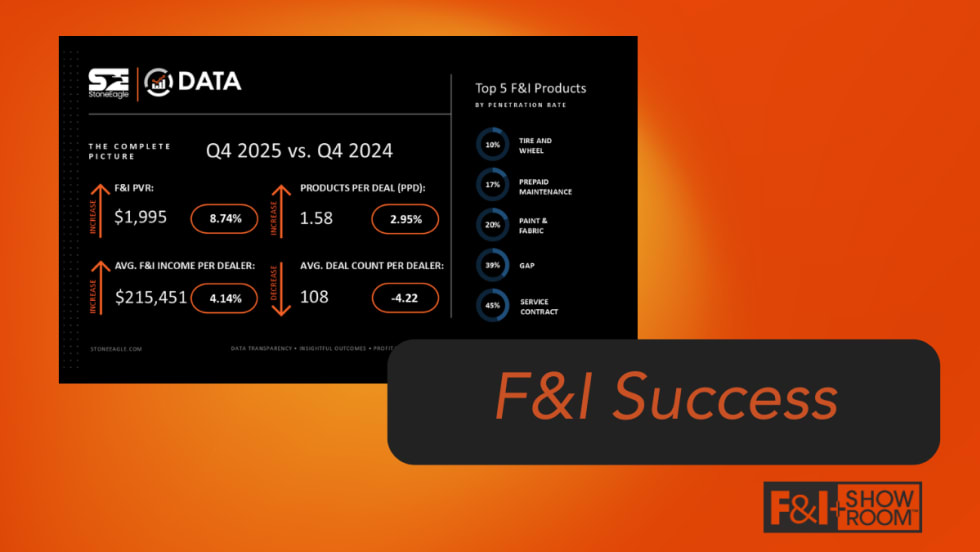
Report Finds Year-End F&I Strength

Deal volume ebbed and flowed throughout 2025, but product performance remained steady, according to automotive technology and data intelligence solutions provider StoneEagle.

Read More →
Industryby Hannah MitchellFebruary 24, 2026

Overall Consumer Confidence Up

Americans’ view of present business conditions, the labor market and family finances, though, are still in the dumps, and if they plan to buy cars, many target used units.

Read More →
Auto Financeby Lauren LawrenceFebruary 23, 2026

Auto Loan Forecast Bucks Market Trend

Auto loan originations rose over 6% year-over-year in the third quarter of 2025, but TransUnion predicts a slight decline in auto loan growth this year, making it an outlier in the company's overall lending forecast.

Read More →
Ad Loading...
F&Iby Hannah MitchellFebruary 23, 2026

Some Auto Brands Cheaper to Insure

A new top 10 list ranks the least expensive for average full insurance coverage on a clean driving record and high driver credit scores.

Read More →
Industryby StaffFebruary 20, 2026

Learn to Manage the Mayhem at Agent Summit

Rob Mancuso – president of Mancuso Automotive – will present a Keynote at the 2026 event.

Read More →
Fixed Opsby Hannah MitchellFebruary 20, 2026

Auto Recalls Sank Last Year

2025 Sedgwick data indicate that the number of vehicles affected fell to its lowest point in more than a decade.

Read More →
Ad Loading...
Industryby Lauren LawrenceFebruary 19, 2026

Affordability Leads Top-Rated List

Edmunds’ editorial team tested 300-plus vehicles to help determine the Top Rated Awards for 2026, and one brand stood out with multiple rankings, including Best of the Best.

Read More →