A critical question for dealers emerged in their used-vehicle departments over the course of recent months: As wholesale and retail prices rise overall, how can I be sure I’m pricing each vehicle to maximize its performance?
For some dealers, the answer to the question is to maintain their present course. That is, they are operating in “safe” mode, choosing not to stock up on inventory and/or raise prices beyond their normal operating parameters.
Different Approaches
Some dealers are more speculative. For example, a large dealer group raised its used-vehicle prices by 5% at the beginning of April—a “seize the moment” decision intended to drive additional gross. In hindsight, the speculative play proved to be a bit too aggressive. After seven days, the retailer’s sales had dropped 50%, prompting a decision to reduce asking prices. The net result: Sales picked up as the group’s retail asking prices returned to levels its customers and local markets could bear.
Meanwhile, other dealers answer the question in a different way. They are leaning into the artificial intelligence-powered, predictive science-based appraising and pricing recommendations to make confident, market-precise decisions. The data science combines hundreds of data points on each vehicle, the market and a dealer’s experience to recommend appraisal values and price points that help dealers maximize the return on investment for each vehicle and achieve its preferred gross profit and turn objectives. Cox classifies these as gold, silver and bronze, while other companies may use their own category terminologies.
Data Can Help
Here’s an example of how the data science-backed recommendations led the used-vehicle manager at a Hyundai dealership in California to a different, more profitable and ROI-favorable pricing decision. In an e-mail, the manager wrote:
“We had a Palisade that I had maxed out to the top of the Gold-level pricing. I came in the next day, and it switched to Platinum. (The system) said to raise the price. We raised it $2K and just made one heck of a deal. I never would have raised that price in the past. I would have probably gone the other way.”
The manager’s experience wasn’t an anomaly. During recent months of price and value volatility, the data science revealed similar opportunities for other dealers. Some highlights:
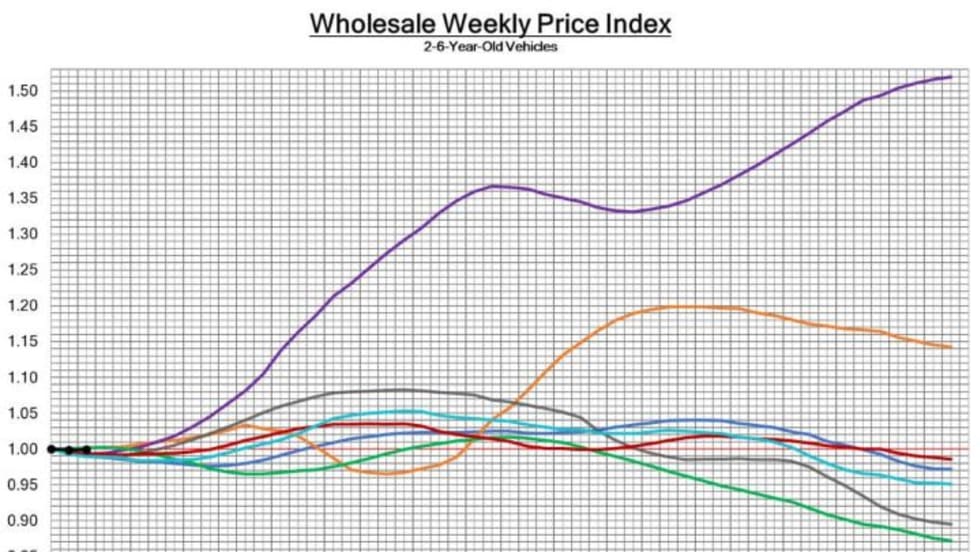
The data science revealed that during the past two months, there were far more vehicles that, thanks to prevailing market winds, saw their investment values improve. The end result: more recommendations to increase rather than decrease retail asking prices to capitalize on the opportunity.
Even risky vehicle investments saw their investment values improve. For example, 39% of vehicles the data science identified as the most-risky, or Bronze-level vehicle investments, saw their investment values improve. The vehicles became Silver, Gold and in some cases Platinum-level investments. The same dynamic played out for Silver and Gold-level investments (see chart). With each vehicle in each investment tier, the system recommended higher asking prices—the experience the used-vehicle manager at the Hyundai store described.
The investment value improvement and related price increase opportunity doesn’t apply equally to all vehicles. This may be an obvious point, but it’s worth noting, given the tendency of some dealers, like the large retailer referenced earlier, to think that because wholesale and retail prices are on the rise overall, the same goes for their current inventories. The truth, however, is that each vehicle’s investment opportunity and value is unique, and the current market’s more price- and segment-sensitive than ever. That’s why the data science recommended higher investment values for only a portion of vehicles in each investment category. With Bronze vehicles, for example, the system recommended that dealers either stay the course or reduce prices on 61% of their Bronze-level vehicle investments.
It appears that while vehicle values and prices remained volatile, the pace of change or fluctuation has tempered. This is good news as dealers head into the months ahead. But as we look forward, we can be reasonably certain that the market will turn again, for better or worse. And, when that turn happens, dealers who are the first to know when their vehicle investment values have changed and how to adjust prices to maximize each vehicle’s performance and ROI opportunity will find the greatest success.
DIG DEEPER: Some Cars See Price Cuts
Derek Hansen is vice president, Inventory Solutions Management and Head of vAuto at Cox Automotive.
EDITOR’S NOTE: This article was authored and edited according to F&I and Showroom editorial standards and style. Opinions expressed may not reflect that of the publication.