The general agent is tasked with assisting dealers on two distinct levels: The first responsibility is to help each dealership develop a profitable sales process as it flows into and through the F&I office. The dealer needs to be assured that they have the right (1) people who are well-trained, a professional F&I (2) presentation, a customer-focused (3) process, quality (4) products that offer real customer value and fair and consistent (5) prices. Guiding a dealership to implement strategies focused on these five “P”s can yield higher profit and customer satisfaction levels.
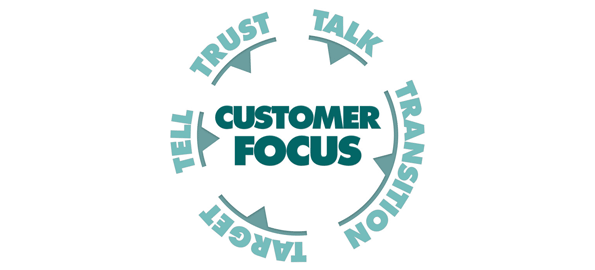
While the five “P”s are fundamental to a successful and profitable dealership, the second focal point for agents is what actually happens once the customer is inside the F&I office. F&I managers that focus on the five “T”s of the F&I process are seeing record acceptance levels of products. Let’s examine each one individually and how it affects the desired end result.
1. Trust
Low levels of customer trust in the F&I process come at a high cost. The level of profit will rise and fall based on the level of trust established. Each part of the process must be filtered through the measure of whether it is building trust. When the F&I manager should first engage the customer, the wait time to get into the F&I office, utilization of an interview or more of a conversational uncovering of needs and, finally, how objections are overcome must all be evaluated in light of the new era of customer service in which we operate.
When the F&I manager is involved early in the transaction, they are viewed as adding value to it. Complete transparency throughout the process causes the customer to open up and share freely when questions are asked and a true and telling needs discovery process takes place.
Today’s sales environment demands we concentrate on getting the customer to open up early in the process rather than focusing our efforts on how to “close” them at the end. When high levels of trust are built it takes less effort and time to move customers to buy. Trust is the “holy grail”; it scores an 11 on a scale of importance of one to 10. Once we become a trusted advisor, we can help customers make good decisions about protecting themselves against future issues. Without a commitment to this foundational concept, maximum levels of production can never be reached.
2. Talk
Every great F&I professional I have ever met is a great listener! They have mastered the skill of talking 30% of the time and listening 70%. Knowing when to talk and when to listen paves the way to high levels of production. Effective use of questions and listening skills is necessary to uncover what each unique customer needs. The focus should be on helping customers, not selling customers. If you are trying to sell, you can go ahead and do most of the talking. However, if you are focused on helping customers you will listen much more than you talk and customers will buy more than you could ever sell them.
The secret to having a genuine conversation is to ask questions, and the quality of information received depends on the quality of the questions asked. The bigger secret is waiting for — and listening to — the answers! Customers don’t want to be talked at. They want to be heard. If the F&I manager has established a good measure of trust, the customer wants to talk and they are more apt to buy when they are talking than when the F&I manager is.
3. Transition
The most important part of the F&I process is how to re-engage the customer after they decline products the first time through and therefore how to transition the conversation back to the customer needs uncovered earlier. We have to make the customer want to talk more about the products. To do this we have to get them to ask us for more information.
We need to use statements that will make the customer “thirsty” for more information. For example, “That surprises me. You said something a few minutes ago that I never expected you to say,” or “That is unusual, especially since you are buying a vehicle built since 2010.” Either of these will make the customer curious to know more. More importantly, this turns the process around. We are now responding to a request for more information.
Great F&I managers use a variety of techniques. The one I hear most often is a direct statement, such as, “I am surprised you are not interested in the service contract.” While this may lead to more VSCs being sold, it also leads to low levels of packages being sold.
The bottom line is that even the best F&I managers can see an increase in overall production with a shift of focus. Make the effort to first turn the discussion around, not to sell a particular product, and you can sell more VSCs and packages.
4. Target
The effort to move a customer to buy a product/package must be targeted and personalized based on the unique needs of each customer. Today’s informed customer will not buy products because others buy them. It has to meet a specific need that they have or solve a future problem they can foresee happening.
Our task is to help the customer see how a future problem can be best handled by taking action today. When an F&I manager runs out of reasons the customer needs a product before the customer runs out of objections, an opportunity to sell that product and help a customer is lost. When the focus is on uncovering needs throughout the process, a more targeted effort is used to overcome customer objections and more customers buy!
5. Tell
Once the process is complete, it is imperative that the customer know everyone at the dealership is committed to making this the best ownership experience this customer has ever had. The F&I manager is in a strategic position to tell every customer the dealership is a resource for all their needs concerning the vehicle they just purchased. This continues the dealership message that we are there to help them not just sell them. This can develop loyal customers that are less likely to cancel any products they have just purchased.
Managing chargebacks is a result of building trust from beginning to end. Telling the trust-building story again as the customer finalizes their purchase enables them to leave with the confidence that they just purchased a great car from a great dealership. It’s a great story and great F&I mangers tell it well!
An F&I process that builds trust, has a balanced talk/listen ratio, transitions seamlessly after the initial no, utilizes a targeted response to overcome objections and ends by effectively telling the story of the dealerships commitment to a great ownership experience will produce record results. Profits and customer satisfaction levels will rise while chargebacks fall.
Some of the record numbers we are reading about are the result of great F&I professionals being open to the changes demanded by today’s more informed customer. They are adjusting their processes to be more targeted and build high levels of trust. The results have been amazing for them and will be for all that are willing to adjust and assure their process is focused on the five “T”s of F&I success!