Small tweaks to your approach can transform a customer from resistant to receptive.
by Ian Vandenbark
December 20, 2023
IMAGE: Pexels/Sora Shimazaki
4 min to read
Here are some difficult questions you may not have asked yourself in a while: Are you a true automotive professional? Are you one to continue eking growth along the journey of your career to discover your true professional potential? Are you willing to get uncomfortable, try new things, and make mistakes?
Many of us have spent days in classrooms, role-played with colleagues, and completed hundreds, if not thousands, of live transactions. We have practiced, drilled, and rehearsed every possible scenario we can think of surfacing during a transaction. When customers have an objection, we have already given thought to the best way to address it—actually, multiple ways. But still, we are often met with resistance. Customers don’t necessarily want someone to “overcome” their objections. They might, however, be willing to listen to someone they believe genuinely has their best interest at heart. Someone who might see an area where they are vulnerable to unnecessary risk.
Ad Loading...
Here’s the reality: Many professionals do not struggle to come up with something compelling to say during the pivotal moments of influence. The struggle is getting customers to actually want to listen. Our world is littered with distractions and external influences. Calming down the noise and narrowing our customers’ focus to our message is essential.
Reposition the Storyteller
So, how do we set the stage? Through intrigue, consensus and storytelling. We must remember that customers often view us through a skeptical lens, so any recommendations we make will likely fall on deaf ears or, even worse, become counterproductive. As an example, if a customer said no to dealership financing because they feared additional credit inquiries, saying, “I understand where you’re coming from, but …,” can increase their resistance. Also, be cautious of “understanding” their position, as it flirts with agreement. Perhaps a better alternative would be to “appreciate” their point of view and set up the story:
“I can appreciate where you’re coming from. I recently had another customer purchasing a vehicle—someone who had bought multiple vehicles from us over the years with their own financing arrangements—and just like you, they feared additional inquiries would negatively impact their credit. However, on their most recent purchase, they decided to let us work on their behalf to discover the best loan structure. This led them to ultimately take advantage of the financing arrangements the dealership could provide. I was surprised based on their consistent history, and I had to ask what changed. Do you know what they told me?”
Now we have created a captive listener to share a story. Without this step, we are simply projecting information onto the customer. Pair that with the reality that many customers don’t put a lot of confidence in our messages because they fear we seek to benefit only ourselves. Taking the above approach, however, means the message isn’t coming from us. It’s coming from someone just like them: a peer.
Ad Loading...
Turn Your Message Into an Answer
Another method that can open the door to being heard is to turn your message into an answer to a question. When you ask a question, what are you waiting for? An answer. If the point you’re trying to make is in the form of an answer to a question, there’s a strong chance your reply will be welcomed. What do I mean by this? Let’s use an example of a customer who doesn’t want to purchase a vehicle service contract, or VSC, because they don’t live near the dealership. In this case, you can turn your reply into a question, essentially setting up yourself to answer it:
“I can appreciate your vantage point regarding a VSC in that situation [empathy]. Others I have worked with previously also had similar hesitations [consensus]. I suppose the question that is really being asked is, why would you want a VSC when living outside the dealership network might make claims more difficult? That’s the question you would be asking, right?”
Now we can proceed with addressing their concern, and they are more likely to listen because we’re answering a question and providing a solution.
The above strategies change the context of how your message is perceived by the listener. Of course, there is no catch-all approach that works for every customer, but these minor tweaks make a difference. As you and your team continue to train and hone your skills, remember not only to practice the message that might address the customer’s concerns, but also how to best set the stage for your message to be heard.
Over half of insurance holders ages 18 to 29 reported to be 'somewhat' likely to change providers in the next 90 days, according to CivicScience, which found that interest was lower among older age groups.
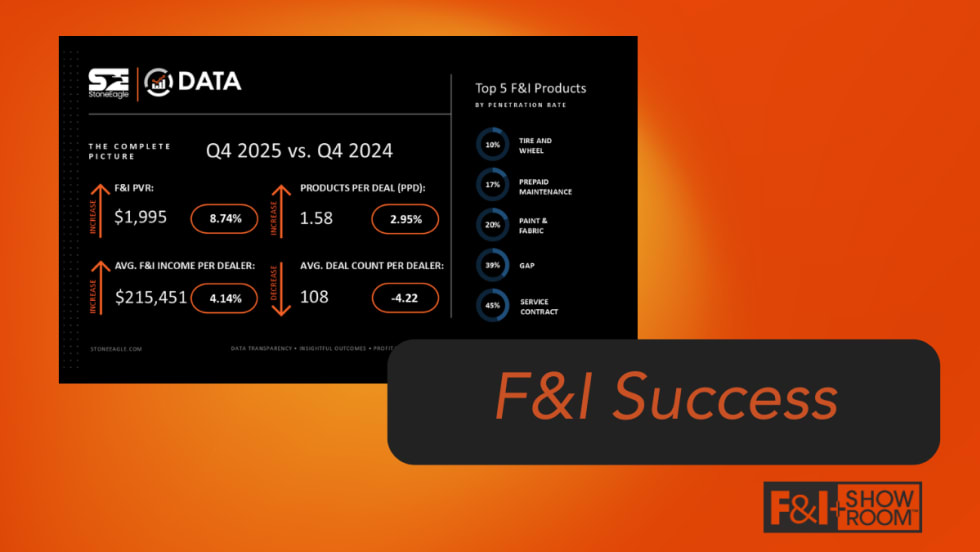
Deal volume ebbed and flowed throughout 2025, but product performance remained steady, according to automotive technology and data intelligence solutions provider StoneEagle.
A TransUnion study found that relationship-driven sales models proved to be important, as consumers who used an agent had a lower shopping intensity than those going it alone.
An annual report on the revenue stream finds more consumers are opting out as they face high car prices and overall inflation, and it recommends tweaks to increase success.
December brought some of the best borrowing availability for consumers in years, though lenders tightened their reins on riskier segments of the market.