There are only a few video recording devices available today for the dealership, among which is the SmartEye video system that IAS offers. It is being used by about 1,000 dealerships nationwide and has recorded over 1,000,000 transactions which saved dealers from a potential multitude of lawsuits. It is so important in this day and age to monitor and record sales transactions in the dealership. Not only does it allow for protection against potential costly lawsuits; it also provides internal or external F&I trainers with a bird's eye view of what is actually happening in the F&I office.
There are two basic forms of video recording systems available for a dealership to use, standard and transaction-based.
Ad Loading...
Standard video systems are basically security systems – they record all day, every day. The challenge with these types of systems is if you want to go back to find a customer transaction, you must know the exact date and time in order to locate the event. And you certainly don't have a way to locate transactions based on other deal criteria, such as whether or not a VSC was purchased.
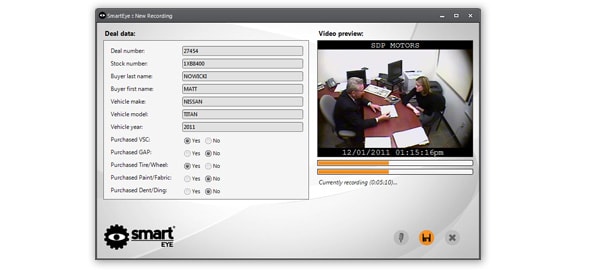
Whereas with transaction-based video recording – video is date and time stamped and stored individually. Along with that video recording all sorts of other details are stored: who the F&I manager was, customer name, vehicle make and model, and which products were or were not purchased. All this information and more is stored in a web-based searchable database. The process starts with the F&I manager sitting at their desk using their own computer that is hooked up to a camera which records and archives these recordings to a centralized server – ours is located in Austin, Texas. This centralized server is accessible over the web by any number of video auditors. The point is that the people who review the videos don’t have to be in the dealership to do so. For example, remote trainers like Ron Reahard or Gil Van Over can use their authorized logins to review videos each and every day.
Deals can be located by customer information (name, stock number, deal number, F&I manager). But you can also locate videos by key F&I metrics. For example, a dealer might want to see a list of every customer who didn’t buy a service contract, or every customer who didn’t buy GAP. This way you can drill down and find out why the F&I manager was unable to quote the deal for those particular products. Lastly, you can locate by any number of custom fields which provides the dealer with the capability to track all sorts of information other than what has been mentioned.
Click to Enlarge
Before and After Example
One of the benefits to utilizing a transactional-based video system is that you can find things that you normally would not be able to catch by non-video auditing techniques. These are things that all the training in the world wouldn’t help you identify. For example, I looked at an F&I manager whose dealership had the program installed for about six months. His presentation and closing techniques substantially improved, he executed the delivery of products as an expert would, handled objections with ease, and his confidence had increased substantially. These changes created a much more polished presentation and set the customer at ease. To be a little more specific, this F&I managers PRU went from $400 to $1,200 in just six months. His customers were extremely satisfied. His cancellations had decreased and he became the best F&I manager in the store.
Keys of Success
With any type of recording tool, there are obviously keys to success. You can’t just put a camera in an F&I office and expect that kind of jump in PRU immediately. The main keys to having a successful video recording system work as a training tool are as follows:
Ad Loading...
1. You must have a review and training plan. This is absolutely critical. Recording transactions just for legal compliance doesn’t mean that F&I will be compliant, and if you are recording transactions just in case there’s a lawsuit down the road, it’s certainly not a guarantee that the lawsuit won’t happen. Part of the review and training plan is determining who’s going to review it. Are you going to have someone in the store, a trainer, a general agent or someone similar do the training? What will they look for? And how you are going to follow-up with the F&I manager as part of this training plan?
2. Develop a plan to insure 100 percent utilization. You want to make sure that every customer who comes through the store is on video. There are basically two different ways to do that: reward F&I managers for utilizing or punish them for not utilizing.
So, first the review and training plan. Video recordings are not just there to protect the dealer, they are a perfect training aid. I think in most cases, when dealers first started implementing video, it was mostly about compliance and protection, but everyone was missing the concept of how important it was for training purposes.
When establishing a game plan, the dealer needs to look at what specific actions they are going to look for when reviewing videos. Specific expectations need to be set based on the experience the dealer expects their customers to have. Do you expect every single customer to go through the process exactly the same? You should! And you need to create a compliance report and have a grading system available to go through these videos. So, that means not just watching a video and thinking “hey, that looks pretty good.” You want to be able to go through and look at measurable items as part of each transaction. It needs to be quantifiable (yes, no, etc.), and it needs to be non-subjective. As far as who should review, we have some dealers where F&I managers review themselves and also review each other, we have F&I directors who do reviews, general agents and outside trainers. Next, determine the frequency of the video reviews and pick a manageable number. It takes time to watch these videos and, you don’t have to watch the “meet and greet,” but what is important is focusing on the menu presentation. Select a manageable number that you can watch each and every month per F&I manager and each F&I manager should have the same number of reviews regardless of whether they are running $1200 per car or not.
That leads right into the second part: the Utilization Plan. You have to make sure that the process is done on 100 percent of the transactions. Dealers can either reward for compliance or punish for non-compliance. An example of a reward that some dealers provide is giving bonuses based on the compliance rate (not PRU) determined from the video reviews. Other dealers do monthly manager meetings and point out excellent videos in front of their peers. There’s a lot a value to doing it that way.
Ad Loading...
As far as punishment, I have seen some dealers establish the “no video, no pay” policy. At least that’s the most common. If the F&I manager did 50 cars, but didn’t report video on 10 of them, those 10 don't exist in their pay plan. Three strikes and you’re out is also common. That means, three videos not recorded and you are done. And just as it's done for rewarding F&I managers, you can also show these to the group in weekly or monthly meetings. This technique might be effective, but can also come across as overly negative if not handled properly.
All video recording systems, provide F&I directors or general agents with statistics on usage. For example, SmartEye sends daily emails and offers reports on demand that allow you to compare the number of deals recorded versus the number of deals that occurred in the store.
Legal Concerns and Litigation History Regarding Video Recording
The first legal concern is not whether or not you can use video, but exactly how that needs to be disclosed to the customer. And the answer depends on the state you are conducting business in. The laws that govern audio recording are state, not federal, and each state falls into one of two categories: "One party" or "Two party." There are several states in the United States that are what we call "Two party" states. (For a clear definition of consent you may want to reference http://www.rcfp.org/can-we-tape/consent-and-its-limits.) Generally speaking, in these states both parties involved in the transaction need to know they are being recorded. So you can post a sign, tell the customer they are being video recorded on video, and/or have the customer sign a form stating they are aware they are being recorded. Any of these ways satisfy the "Two party" rule.
Every other state is a "One party" state, meaning that only one person needs to know, and of course the F&I manager knows because they are the ones who start the recording. So every state in the nation can legally be recorded. It’s just a matter of how you want to disclose it.
What we recommend across the board is that every dealer post a sign stating something like “Our dealership records each transaction for quality assurance and for training purposes.” We also recommend that we get the disclosure of the recording audibly when the customer walks in, “Mr. Customer, it’s nice to meet you. We record each transaction for quality assurance (etc.) and there’s the camera up there.” Not once has the customer ever said, “No, I don’t want to be recorded.”
Ad Loading...
The second legal question is whether or not you should record? Only if you follow the keys to success. If you are going to put a camera in the F&I office and never watch the videos unless a problem occurs, I would not recommend it. Even though that doesn’t help me or any other provider of video technology, I would not recommend people record without following the keys to success. They are very important.
Litigation
What if the State Attorney General comes in and wants to pull every video that you have ever recorded to watch all of them and look for every problem there ever was? This is a common concern among dealers, but in over 10 years of usage nationwide, this has only occurred with SmartEye one time. There were 25 videos for a dealer in California who was involved in a class action lawsuit where a law firm was claiming that Spanish speaking customers were being treated unfairly. In this particular case, those 25 videos were turned over to the California State Attorney’s office upon presenting a subpoena, and the dealer was exonerated and the findings were that there was no wrong-doing on the part of the dealer. So, that is one occurrence out of a million deals.
In all, video recording is not only essential for perfecting the sales process and customer satisfaction, it is a system that allows for training and compliance all rolled into one.
Over half of insurance holders ages 18 to 29 reported to be 'somewhat' likely to change providers in the next 90 days, according to CivicScience, which found that interest was lower among older age groups.
Total visits to dealer websites from generative artificial intelligence platforms grew more than 15 times year-over-year, signaling a shift in how many consumers shop for cars online.
In the U.S., Honda has the most efficient gas-electrified combo lineup while Tesla beats all automakers in annual EPA ranking as brands built their alternative-fuel offerings.
Deal volume ebbed and flowed throughout 2025, but product performance remained steady, according to automotive technology and data intelligence solutions provider StoneEagle.
Americans’ view of present business conditions, the labor market and family finances, though, are still in the dumps, and if they plan to buy cars, many target used units.
Auto loan originations rose over 6% year-over-year in the third quarter of 2025, but TransUnion predicts a slight decline in auto loan growth this year, making it an outlier in the company's overall lending forecast.
Edmunds’ editorial team tested 300-plus vehicles to help determine the Top Rated Awards for 2026, and one brand stood out with multiple rankings, including Best of the Best.