Agent spreads the word of abundant opportunities for himself and cohorts in unexpected places while promoting each other.
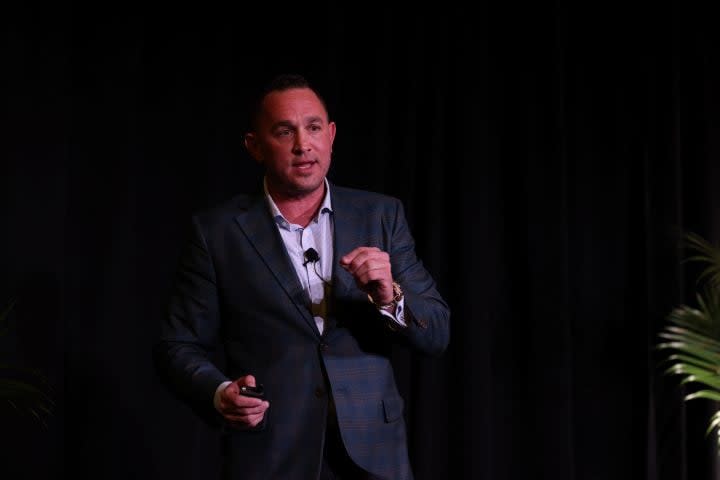
Adam Marburger is passionate about many things, but the energetic agent largely reserved himself to two of them when he spoke to colleagues at the recent Agent Summit.
The CEO of Ascent Dealer Services, whose mission is to “become the standard in F&I,” focused his talk on nontraditional business opportunities and the idea of sharing those opportunities with fellow agents.
Marburger has developed himself into an industry specialist in both subjects as an agent who deals partly in products that have nothing to do with auto retail, as well as one who builds up competitors.
He encourages other agents to adopt both practices, and to illustrate the need for them, he started his talk by making an uncomfortable point.
“Agents, sometimes we're paranoid, like, we're insecure,” he said. “Sometimes – some agents, not all, I'm speaking broad here – we're always looking over our shoulder. We're always worried about somebody knocking on our door at the end of the day.”
Such paranoia is a waste of energy, Marburger essentially said, because agents need to worry about neither losing business to competitors nor running out of opportunities. That’s because opportunities are virtually inexhaustible and therefore plenty for everybody, so agents should stay open to alternatives to traditional business.
“You just never know where the next big deal is,” he said.
Spreading Risk
Marburger’s own business portfolio is a good case in point. In addition to Ascent, he has six other verticals, including an agency he co-founded with Max Zanan that provides warranties to dentists. The business partners have since expanded into medical testing labs and prosthetics and are in talks with a dental chair manufacturer based in Germany.
“Wherever there's risk, there's an opportunity for insurance, and where there's insurance, depending on the structure, there's an opportunity for reinsurance,” Marburger explained.
“These opportunities are right in front of us. We just got to pay attention to it – plastic surgeons, solar companies, insurance agencies.”
There is also potential for new business with third-party administrators and product makers, which don’t always have the training and development regimens they need, he added.
“Why not work with another agency and say, ‘Hey, listen, I got your back. Like, I get it you.’ If you have the relationship, you set the meeting.”
Sharing Support
The variety of opportunity Marburger described underlined his other major point: intentionally helping competitors in order to build on opportunities for oneself and everyone else.
“Instead of hating on our competitors and talking bad and being so stressed out every single day because we're worried about losing a deal, it's about the relationship that we have,” he said. “It's the value that we bring.”
Reaching beyond his business, Marburger has made a point of connecting with other agents and even actively promoting and celebrating them on social media channels. He said some in the industry “heckled” him around 2017 for all his video and other posts. but he persisted and reaped benefits, including the business with Zanan, he said.
“When it comes to your branding, believe in who you are, believe in what you do, and really shout from the rooftops,” he said, warning that doing so will unavoidably bring naysayers out of the woodwork.
While promoting other agents, he markets his own businesses through videos on social media because he found that platform to be by far the most productive, and marketing to be the most important factor in business success because it turns leads into sales.
“I will tell you that for 90% of my acquisitions, I don't knock. I haven't knocked on a door in five years. Ninety percent of my personal acquisitions are inbound leads on LinkedIn and on Facebook. It's because I share other people's content. I stay positive.”
Growth Mindset
That principle applies also to an agent’s own team, Marburger said, giving his agency as an example. In the six years since he established Ascent, he said he’s gradually come to realize that relinquishing some of his natural need to control conditions and instead give employees more agency benefits the bottom line.
“… my business grew when I gave people the autonomy to go out and grow on their own, and me just to be there, to be a support system.”
Considering the agent paranoia Marburger mentioned earlier, along with some agents surely leaning toward the control-freak side like he was, Marburger posed another uncomfortable idea: Agents shouldn’t worry about competitors or letting go of control but about themselves.
“Our real competition is the person that you look at every single day in the mirror,” he said. “So here's my real challenge – when you find yourself getting negative about our competition, you need to reset, look in the mirror. What are you doing to better yourself every single day? What are you really doing to grow yourself?”
Marburger tossed out a few growth seed ideas for agents in his audience, including his habit of preparing for each day the night before and approaching business in a structured, organized way.
“…we are the reason we do not have the things that we want, and by the way, we can have all of it,” he said.
Little-Box Advantage
Working on oneself makes sense because the agency model has an advantage in the market and should take maximum advantage of that, Marburger said. Even more them themselves, those agents really compete with big-box operators in the segment, and the former have the upper hand in the matchup because they’re nimble.
“They go really slow,” he said of the big boxes. “We’re the center console – it goes fast and it turns really, really quick. We’re big enough to service it all, but we’re small enough to actually care … We’re able to quickly identify an issue and get involved early.”
To maximize their advantages, agents should make a point of establishing their core business values, advised Marburger. Ascent’s are prioritizing faith and family first and doing everything with excellence. Its fourth – abundance – follows the first three, he said.
“I talk to business owners all the time. They don't even have a mission statement. They don't have a vision statement. They don't even know what the hell their core values are,” he said.
“… if you don't have these things, write this down, put it into practice, spend some time on it, and make it like nonnegotiable. You will build your company based on this.”