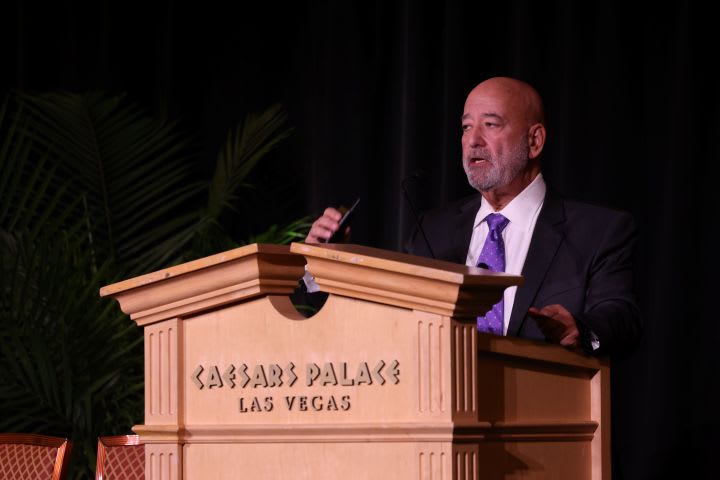
Training veteran Peter Chafetz shares his well-researched approach to prospecting for the greatest level of return.
Peter Chafetz wisely empathized with the agents who attended his address at this year’s Agent Summit. Part of their work, he pointedly acknowledged, means regular exposure to rejection, and nobody likes that.
The empathy came when he pointed out that many agents limit their cold-call prospecting of dealer clients because of that painful reality, which he said also limits how far they take their business.
That’s because prospecting is basically a process that generates a constant flow of business leads and keeps the agent in the driver’s seat. If there’s a pause in that process, business slows to uncomfortably low levels, Chafetz warned, while also validating that the process is often uncomfortable.
“Nobody likes to get punched in the face, and sometimes that's exactly what prospecting feels like,” he said. “Reluctance is real. It's natural, and accepting that fact is your first step on the road to becoming better.”
Mind Over Meh
That kind of self-acceptance – and agency owner acknowledgement of the pain in the case of staff sales representatives – is crucial to the mindset Chafetz said agents need to grow their business and succeed at high levels.
That’s because drumming up and sustaining business take sticking with prospecting, “which is the hard work you have to do after you've already done the hard work,” said the national training director for Allstate Dealer Services.
Getting self-generated or outside understanding helps you keep going.
Chafetz should know. He’s been in the auto retail training field for about 30 years and conducts the kind of market research his clients don’t have time to do.
His key takeaway from decades of observing and learning, he said, is that the agent’s mindset controls his or her success like a steering wheel controls a car. And one can decide to be either a thermometer or a thermostat, the former reacting to the environment, the latter managing it.
Once the pain of rejection is normalized and the agent ideally decides to operate like a thermostat, he or she should cultivate a set of mindset principles that can propel the prospecting process, Chafetz said:
Positivity – self-explanatory
Persistence – continuing despite obstacles
Perseverance – the ability to overcome the obstacles
Resilience – not allowing setbacks to undercut confidence
Put on Your Prospector Hat
Armed with a strong mindset, the agent can then execute optimally in prospecting.
A dramatic 44% of sales reps give up after just one follow-up prospecting attempt, Chafetz said studies have found. So think of all the opportunity you could tap that all of them have left for the picking.
In addition to keeping an agency’s pipeline full, continuous prospecting provides a continuous revenue flow, smoothing out the ups and downs of the sales cycle, he said. Lastly, it allows the agent to focus on the prospects most likely to become clients.
“When's the last time a dealer came to you, knocked on your door or called you up and said, ‘Hey, I want to do business with you.’” Chafetz asked his audience. “It may happen once in a while, but just like that thermometer and thermostat process or conversation, being proactive keeps you in control.”
For the greatest chance of success, Chafetz recommends a mix of methods while always keeping the focus on the prospect, regardless of the method. What are the problems the person is facing, and how can you solve them? Asking questions, including open-ended ones, beats “telling” anytime.
Of course, there are cold calls and warm calls, or outreaches. Newer ways to cultivate the warm ones are social and business media sites, including LinkedIn in the latter category.
Agents can also hire marketing agencies to manage the process for them, and Chafetz says he’s tested that method with impressive results. “Some of their follow-up is absolutely incredible.”
Cold calls or drop-in visits shouldn’t be discounted, though, he advises, and that includes email efforts. “If you want to be a thermostat, this is what you’ve got to do, if you want to make the living, earn the money, that you want to earn.”
Don’t Drop Them
Part of the persistence that Chafetz sees as crucial to prospecting is the time-tested concept of follow-up, or staying on each prospect’s radar. He recently saw the power of it personally.
An insurance company representative had been trailing Chafetz consistently. “She's been contacting me every six months, and I thought that was kind of odd, and then it dawned on me – she contacts me when my renewals are coming up because they used to have my homeowner’s and my auto.”
He’d ignored her phone calls, so she texted him, and he also ignored those messages. Undeterred, the rep emailed him, and he ignored those, too, “because she’s just an interruption in my day.”
Then Chafetz realized the woman is a prime example of the power of follow-up, so he called her, not to take out a second policy, because her proposal didn’t beat his current one, but to laud her for her persistence.
“She just said to me, ‘That's OK. I will call you in six more months.’ That's the mindset that you need to have,” he recalled. “Perseverance is not a long race. It's many short races; they just happen to be one after another.”
For one, it helps to keep in mind that “each no that you get is likely to get you closer to the yes that you're looking for. It's a numbers game.”
Value Proposition
Another way to maintain a positive mindset in the face of potential rejection is to keep in mind successes you’ve had with current or past clients.
“That’s a gift that you to have to bring to a prospect, Chafetz said.
And work on the basics to help you build that, not only for potential clients, but for your own confidence:
Practice, including role-playing objection handling.
Develop a prospecting game plan based on goals that can be measured with the desired end results in mind.
Know your expertise to determine your ideal candidate profile.
Leverage your creativity to differentiate yourself from competitors.
Know why you’re reaching out, because different jobs require different tools.
‘No’ Busting
For the inevitable rejections during prospecting, Chafetz advises adopting a three-step approach to keep yourself grounded so the painful “punch in the face” doesn’t throw you off guard.
The first step is to “anchor” yourself, or mentally take a step back to give yourself time to regain your wits. That’s because any type of rejection can trigger a person’s fight-or-flight response, which renders one temporarily offline when it comes to logical thought or action.
Then you can disrupt the prospect’s objection mindset by responding with something unexpected.
For example, Chafetz said, if a potential client says he’s not interested – the punch in the face – you, through practice, can come back with a preprogrammed response so that you don’t have to think on your feet so much when you’re in recovery mode. You might say something like, “I’m not surprised,” he said.
“It's really just a fraction of a second for you to regain your footing, and then you disrupt that particular prospect’s thinking by saying something like, ‘You know, if I were happy with my current provider, I wouldn't be looking to make a change either. But you know, since I'm here, maybe we can just have a little conversation. I can share some information with you, if for no other reason than to give you peace of mind for the future to know that you got a good deal.’”
The last step in responding to rejections is simply to ask a question, Chafetz said. That is, ask for an appointment, doing so confidently, “as if this is not a big deal for you.”
At that point, you’ve given yourself your best shot at getting a meeting, and if the answer is still no, you must accept that it’s time to walk away, and it’s on to the next door, he said.
“There's a fundamental rule of human nature – you cannot argue somebody into thinking they're wrong.”
Hannah Mitchell is executive editor of Agent Entrepreneur. A former daily newspaper journalist, she honed her craft covering politics, business and more for publications that included the Charlotte Observer and the Orange County (Calif.) Business Journal. She holds a master’s degree in journalism from Columbia University, and her first car was a hand-me-down Chevrolet Nova.