



When it comes to technology, auto dealers have an embarrassment of riches.
With the rapid advancements of this stage of the Information Age, high-tech and data offerings abound. The challenge can be which to choose and how to best leverage them.
 MENU
MENU SEARCH
Product providers offer agents tips on how to guide dealer clients in choosing the best tools for them.

Auto dealer tech specialists Mark Nagelvoort, Cindy Allen and Joe Pesce discuss recent trends and how agents can help dealers cherry-pick the products and methods that work for them.
Expo Ease
When it comes to technology, auto dealers have an embarrassment of riches.
With the rapid advancements of this stage of the Information Age, high-tech and data offerings abound. The challenge can be which to choose and how to best leverage them.
That’s where agents come in.
Auto industry tech specialists who tackled the topic at this year’s Bobit Business Media Agent Summit tried to cut through the noise to help agents help dealers with technology that changes about as fast as artificial intelligence can spit out an answer.
The experts seemed to agree on a couple of foundational truths. First, tech tools shouldn’t be relegated to one or two corners of the dealership.
“We have to look at technology throughout the whole dealership, not only the F&I office,” said panelist Mark Nagelvoort, CEO of PCMI, which provides F&I product administration software.
And industry relationships supersede any technology, every time.
“Despite all the added technology, knowledge and connections, we think the relationship is still king,” said StoneEagle CEO Cindy Allen. And that’s coming from an F&I and service drive tech provider.
The panelists acknowledged that the deluge of new technologies can be overwhelming.
“Expectations are higher than ever,” Nagelvoort said. “Consumers want self-service portals. Dealers want the ability to submit directly and are trying to drive down fees. Everyone wants everything electronic.”
But Allen emphasized that agents must find a way to stay abreast of the developments so they can meet dealer needs and demands, which are growing right along with the tech.
“All of it changes so rapidly,” she said. “Being plugged into it constantly is so important.”
But how to narrow it down to what fits dealers? Perhaps the most important measuring stick is for agents to sift through the data to see which tools are most effective, Allen said. That proves dealers’ investments are producing a commensurate return and “they really understand what’s truly driving profits.
Doing so allows an agency to “fail fast” so it can make adjustments and “repeat the process until you dial it into the absolute best version of whatever you can bring to your dealer or to your own agency,” she said.
Data optimization involves sorting and analyzing the growing volume of information to attain a usable structure for assessing products so the agency can prioritize in-person time with dealers.
Agents themselves are even contributing to the tech tsunami, but in a way that benefits both them and the dealer, said panelist Joe Pesce, CEO of software provider TecAssured.
“You have creative ideas,” he told the audience of agents, encouraging them to pursue them in order to carve out niches for dealer-clients.
Traditional key performance indicators, such as PVR and PPD, are sound, Nagelvoort allowed, but he said more should be employed to help dealers increase contract sales.
“I think we've done a great job in the F&I office. I don't think we're doing enough to help dealers sell cars,” he said, pointing out other programs that can better optimize sales, including for gap coverage. “How do you use this whole dealership as a wealth-creation engine?”
Allen agreed that PVR and PPD remain guidepost indicators for F&I sales but also mentioned other drill-downs that can unearth additional opportunities. For instance, identifying the most effective vehicle service contract mileage ranges without pricing out customers, or analyzing how much time service technicians spend on paperwork versus working on cars or upselling to customers.
“Those investments can go a long way, and that data can drive a lot,” she said.
New consumer-facing products are also producing new metrics that dealers can tap to bring in additional revenue streams, helping both the customer and the business, Pesce said.
“It’s information.”
Not surprisingly, artificial intelligence figured in the panelists’ discussion. The rapidly advancing technology seems to be touching everything nowadays, and auto retail is by no means an exception.
The most practical result of AI work is currently in providing advance information on consumers before they enter the F&I office, Pesce said.
“So you know what to sell them … When you're sitting in F&I, the more information you have about the person in front of you, the better off you are with the actual products that are being presented.”
AI can also act as a sort of office generalist, doing everything from simple route planning for field agents to maximize time with dealers, to helping sales staff role-play objection handling and analyzing their techniques for training purposes, Allen said. It can also analyze data to determine the most effective ways to approach customers and gauge their likeliness to buy.
But Allen was quick to add that AI should be utilized with caution because of its potential to generate incorrect information, a risk that has resulted in some lawsuits. Ensuring that data fed into AI systems is not only valuable but correct is essential, she said.
“Actual intelligence has to kind of work hand in hand with it, or you end up in a ditch instead of on the road to where you want to go in leveraging it.”
AI can also help agents streamline dealers’ operations and thereby strengthen agent-dealer relationships, Nagelvoort said.
Amid all of the waves of technology, agents stand to be dealers’ guiding lights, the panelists said.
First, they should expand their technical expertise to even better advise dealers on which avenues to go down and which to avoid. Today, like it or not, they’re considered a “support technician” in part, Allen said.
“Dealers still look to our agent partners to make recommendations. And it's not just recommendations for the sake of technology, it's recommendations for the sake of fit, for what's happening in their market, for what's happening with their particular dealers and their particular brands or in their particular area of the country,” she said, adding that agents can serve as “anchors” of contact between dealers and product providers.
Second, agents can leverage their tech expertise to help dealers understand young consumers, Nagelvoort said.
“You can understand the importance of putting the F&I products on your websites, point-of-sale follow-up campaigns, make sure they can get to all their F&I products through a consumer portal.”
It’s also important for agents to keep a full solutions catalog through providers that offer that, he said, so that they never have to say no but instead quickly set up dealers with everything they need.
Providers can also “expand” the agent’s team through their support systems, as well as automating agents’ tasks to free up more of their time, the panelists said.
Closely related to that, agents should choose partners that will stick with them through good times and bad, Allen emphasized.
And agents can even transition to become their own third-party administrators, Pesce shared.
“You truly do build the organization that you want.”
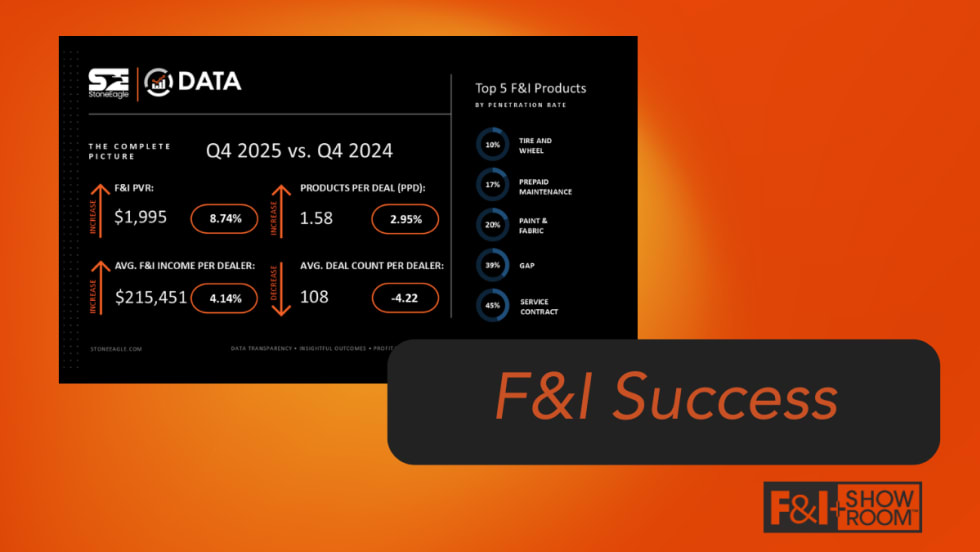
Deal volume ebbed and flowed throughout 2025, but product performance remained steady, according to automotive technology and data intelligence solutions provider StoneEagle.
Read More →
The strategic combination is intended to expand technology-driven compliance solutions for the automotive industry.
Read More →
2025 brought consumers relief after years of rate hikes, but 2026 could bring renewed policy pain, depending on how U.S. trade policy affects prices.
Read More →
Empowering the F&I office through data is central to the company’s reimagined solutions it's scheduled to debut soon.
Read More →
The most common artificial intelligence applications in automotive retail include customer communications, scheduling, reporting, marketing content and handling of online leads.
Read More →
More OEMs and U.S. auto parts makers joined the global initiative to leverage open-source software development for greater efficiencies and vehicle innovations.
Read More →
Protective Life Corp. closed its acquisition of F&I company Portfolio Holding Inc., expanding its Asset Protection Division across the automotive, RV, power sports and marine sectors.
Read More →
Frost & Sullivan expects a $238 billion market opportunity for the technology in automobiles by 2030 as AI applications shift to more mass-market applications.
Read More →
The quickest way to turn a breach into a crisis is to wing it. Follow this seven-step playbook to ensure you meet your obligations.
Read More →
Personalized messaging is increasing appointment conversions by 26%, Cox Automotive says.
Read More →