



"We've recovered and we're making money again. How can we increase our unit sales without dropping our average gross per unit?"
This question brings up a few key points that we need to discuss before I can actually answer the question.
 MENU
MENU SEARCH

Improving Dealership Growth Means Increasing ‘Good’ Gross
"We've recovered and we're making money again. How can we increase our unit sales without dropping our average gross per unit?"
This question brings up a few key points that we need to discuss before I can actually answer the question.
When you look back at the last 20 or 30 years in this business, everything about what we’re supposed to do in management – who we hired, how we sold cars, our daily work habits and even what we thoughtwas the right way to do things – were all distorted by a great market.
In the last two or three years, just the opposite happened and our actions were controlled by fear. So let's do a quick reset on our thinking and our habits and start back at common sense again.
Too many dealers and managers are confused about recovery and growth. I'm hearing managers say, "We don't need to read your book A Dealer's Guide To Recovery & Growth In Today’s Market or go to classes because we've recovered and are making money again."
If that’s your thought too, it’s great that you’ve whacked expenses enough and have stabilized your unit sales enough to start turning a profit again.
Recovery: return to a normal state
When I talk about recovery, I'm not talking about cutting the fat and learning to make a profit off a smaller volume. When I talk recovery, I'm talking about getting back to the volume you were at before everything tanked and I'm betting you aren't even close yet. If you’re making money at lower volumes, do the math on what you'd be making at your previous volume levels. Your potential net profit is HUGE!
Until you get back to normal, which would be your previous volume levels, you have not recovered yet. Even if you're making money off of lower volume, your sales force (the people you depend on to make those sales) and a lot of your other employees are not back to their previous income levels. When you really get back to normal, so will they.
Growth: the process of increasing
We have the same problem with the word growth. People confuse having a good year or making money with growing. That isn't growth, it's simply having a good year or making money.
After you actually recover to your previous levels before the crash, growth would be improving your unit sales above that previous level, and then continuing growth, year after year.
Most of us were also led to believe that if we increased unit sales more than a little, it would be at the expense of gross – we might be able to make it up in volume.
Profits through volume can certainly be a possibility with incentives from your manufacturer. But the gamble in spending big on advertising and then hoping you can hit the magic number for the incentives is too much for most dealers. Remember on betting the big bucks on ads to hit the incentive...
Hit the incentive and make a bundle, but miss it by one and you'll lose a ton.
I'm all for volume bonuses, and yes, you'll probably have to advertise more to some of those, but– and this is a big but – you can increase sales without losing gross as long as you don't give up the value.
Low gross comes from cheap selling your product. Advertising brings more people on the lot, but that doesn’t mean you stop building value. If you teach your salespeople to sell the car, not the price or incentives, you’ll have no problem maintaining gross on each unit you sell.
Once we're all on the same page on what recovery and growth really mean and that you don’t have to dump the gross just to make a deal – the answer to the initial question is simple...
You just need to set clear volume goals and then using clear activitygoals, you can control how you make those sales.
You're not required to lose gross. You can increase your gross profit at the same time that you increase your sales volume, if you do it right. Let's take a look at the steps to increasing both your unit sales and your gross profit.
Which goals apply to your dealership?
We want to increase our "Unit" sales
We want to increase our "Gross" profits:
As we increase our gross, we want to generate:
"Good" Gross
"Bad" Gross
We want to increase our net profits
We want to build our repeat business up to 70 percent to 80 percent of our total sales
You may have decided all the above applies to you, except 'bad gross' of course, so the next question would be…
We'll increase our ad budget to generate more traffic
We'll hold more special events to generate more traffic
We'll hire more salespeople
In No. 1 above, if you wanted to increase units, gross and net profit, there's a catch with the three ways to grow that I just listed in #2.
With more advertising, more events or by hiring more salespeople, you may increase unit sales, but you won't increase gross profit per unit or net profit. In fact, if you spend more money trying to generate more traffic, you'll generate bad gross and net profit may actually take a hit.
Let's assume you're a 100-unit store with $2,000 gross, front and back. Increasing unit sales is easy and you can increase unit sales several ways. The problem is GROSS. So, let me explain what we mean by good gross and bad gross, and why it’s so important to plan your growth in unit sales and good gross so in the end, you make more money.
Bad Gross:gross generated at great expense
If you spend $20,000 to have an event that brings in 20 more units, it sounds like you did well. You spent $20,000 and generated $40,000 in gross profit.
But that's $40,000, minus $20,000, minus sales and management compensation of roughly 40 percent ($16,000). That only leaves $4,000 or so after everything is paid ...if you're lucky.
I'm not suggesting you shouldn’t have events to move old units or to sell more overall. Those extra units may help you over the volume hump for the incentives. Just don't think you're hitting home runs with most events or that you're actually building your business.
There is definitely value in turning inventory and generating more gross, but that isn't growing, that's just selling a few more because you spent more money on advertising. Remember that when you stop spending more, your sales volume will drop back to where it was before.
Good Gross: gross generated at no extra expense
Good gross is any gross you generate without spending extra money to get it. It's good gross, because the only expense is sales and management compensation. That means 60 percent of good gross heads straight to the net profit line.
How can you increase gross without spending more money?
Assume you sell 100 units, which means you have about 500 prospects on the lot each month (500 prospects x 20% closing ratio = 100 deliveries).
Here are four ways to dramatically improve your volume and net profit, all without spending any extra money except for the training to make it happen.
Teach your salespeople to do a better job of selling the 500 people who are already on your lot (no new expense). If they'll spend less time prequalifying and more time selling and building value, you can easily sell an extra 20 units, and that means you hit a serious home run compared to an extra 20 units from an event.
You still generated $40,000 (same as the event) but only pay out $16,000 in sales and management compensation, so you end up with $24,000, which heads straight to the bottom line.
You paid $300 or so to get them on the lot the first time, but they didn't buy. It'll cost you about $2 more to try and get them back in, so we won't even count that as an expense.
You had 500 on the lot, sold 100 and that means 400 left without buying. Get 75 percent (300 names and numbers) by learning how to ask, follow up effectively with all of them and 33 percent (100) will come back in. You’ll deliver 67 percent (67) of them a vehicle on their second visit. To save time and space, pretend 67 is a highball and cut it to 50 – better yet, cut it to 40 – ah, what the heck, cut it all the way down to 20, and you'll generate another $24,000 in net profit.
In the average 100-unit dealership, you'll get 150 sales calls per month. Ninety percent are buyers (135) but you'll only average six deliveries and miss 129. Could you get them all in? No, but with training, you could get another 20 or so. There are also no new expenses, because you've already paid to make the phone ring, so that's another $24,000 in net profit.
Gross profit is relative to value. That means if you want to hold even more gross on every sale you make, just train, coach and manage your salespeople more effectively, so they stop talking price and start building value. This is instant opportunity and you can make it happen tomorrow.
Raising the gross another $300 per unit on the 100 units you sell now is a piece of cake and you can do it tomorrow, too. There are no new expenses here either, except commissions. That generates another $30,000 in gross, less 40 percent in sales and management compensation for another $18,000 headed straight to your bottom line.
Additional Gross Profit / Month, from 1-4.........$150,000
Total New Advertising Expenses....................... $0
Additional Net / Month, After 40% Comp.........$90,000
Doubling your net profit is easy! You're already making money again and you haven’t even fully recovered your unit volume. Don't fall back into the same old trap of spending two tons on advertising, trying to climb back up the ladder.
Get your salespeople and managers trained and you'll sell more units now, increase your 'good gross' profit and by training daily, you'll grow every year that you keep training.
Before complacency sets in again, make one serious commitment: Get everyone trained properly, so you can grow!

There are tried and true ways to instill it while also protecting your agency from competitors and other roadblocks.
Read More →
February forecast has new-vehicle deliveries still off from last year at this time amid high prices and vanished EV incentives. But J.D. Power sees business picking up from here as automakers target growth.
Read More →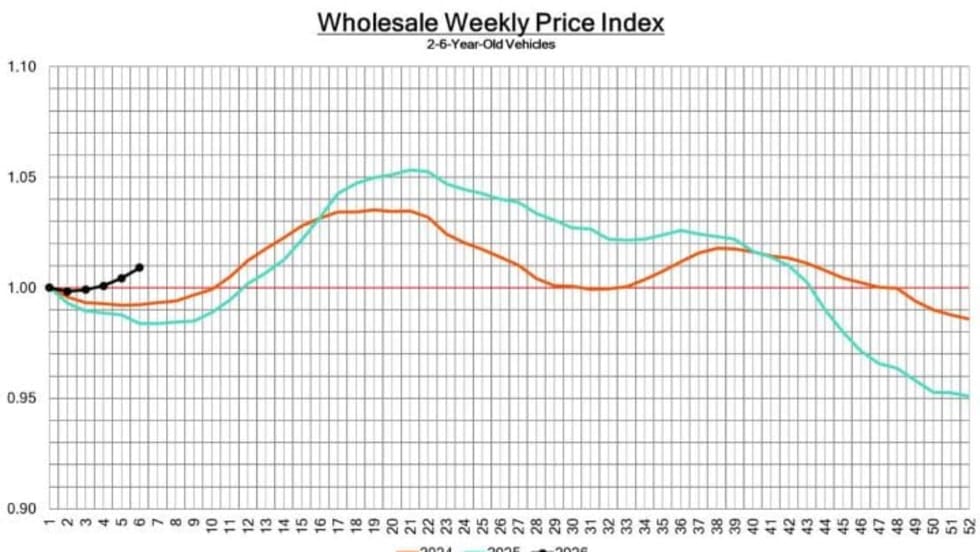
Many vehicle segments experienced gains last week as conversions picked up. Meanwhile, the retail days to turn estimate stood at 39, analysts reported.
Read More →
Over half of prospective car buyers responding to a TransUnion survey expressed intent to purchase a gas-powered vehicle this year.
Read More →
The year starts with declined expectations for economic conditions and plans to make big purchases. Used cars, though, are among the top big-ticket categories under consideration.
Read More →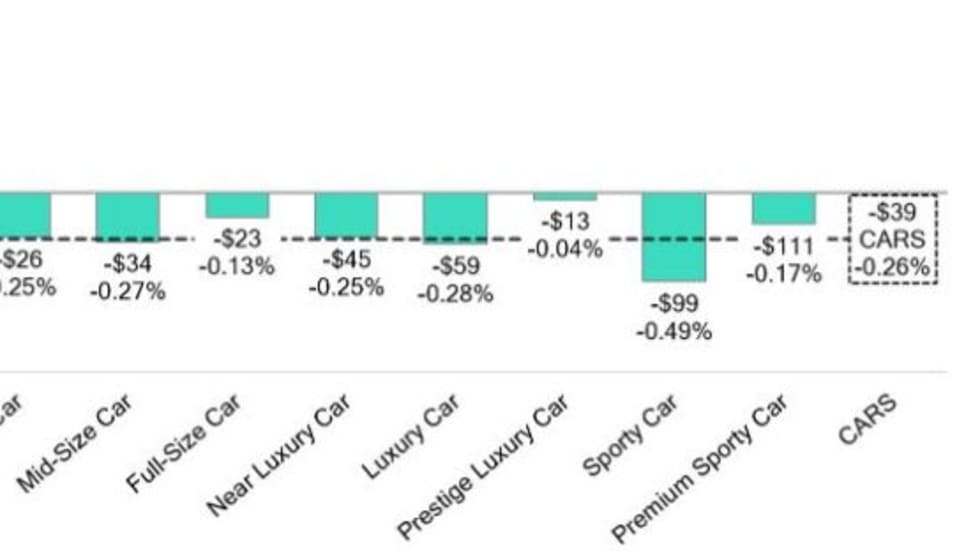
Some automotive segments actually improved last week in a bright midwinter sign that could signal a healthy spring season.
Read More →
The month is set to be off last year, J.D. Power predicts, though its full-year outlook is less gloomy, and dealer profits are up despite the odds.
Read More →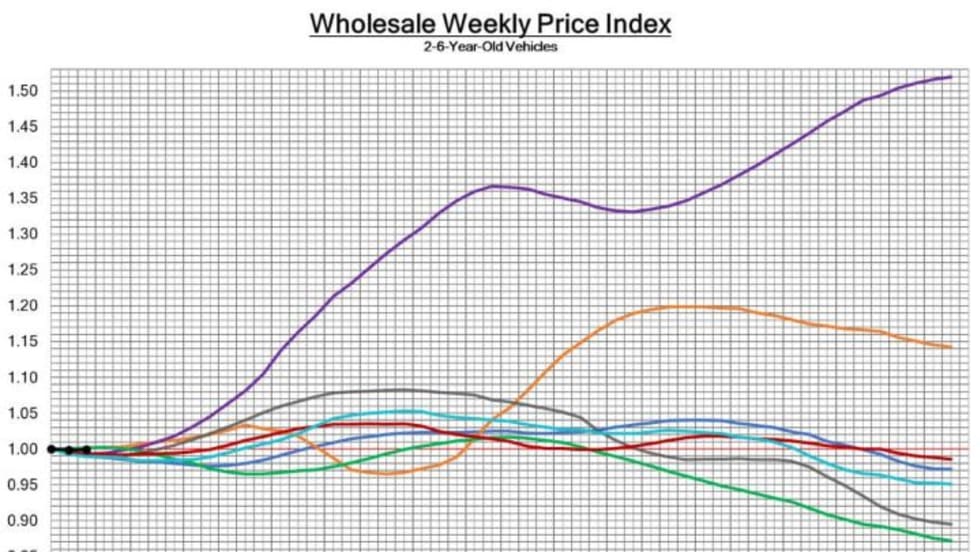
Could it be an early spring when it comes to used-vehicle sales? Black Book analysts think so based on recent weeks' auction activity.
Read More →
Auto consumers reported greater satisfaction last year despite higher prices and rising tariffs, due to an omnichannel approach blending online and in-person shopping, Cox Automotive research found.
Read More →
Purchases of new and used vehicles were down in December despite several positive market turns for consumers, whose optimism didn’t match their big-ticket spending.
Read More →